Why Central Indiana crawlspaces need attention
Many homes in Westfield, Carmel, Noblesville, Fishers, and the rest of Hamilton County sit over a crawlspace. In climate zone 5, that space works through cold winters and humid summers. A vented or unsealed crawl is connected to the outdoors, so it runs cold in January and damp in July, and the floor above feels it.
Hoosier Spray Foam is based at 15001 Shelborne Road in Westfield. We encapsulate crawlspaces across Central Indiana by sealing the ground, the foundation walls, and the rim joist so the crawl behaves like part of the house instead of part of the yard.
- Stack effect
Warm air rises and leaves through the upper house. Replacement air gets pulled in low, often from a vented crawl or a leaky rim. That is cold, drafty floors in winter and humid outside air in summer.
- Ground moisture
Bare soil and thin plastic let ground moisture evaporate into the crawl. That moisture ends up in the wood framing and in the air that moves up into the living space.
- Cold floors and comfort
An open, uninsulated crawl leaves the first floor sitting over cold air and cold foundation walls. Sealing and insulating the perimeter keeps that space closer to indoor conditions.
Sealed vapor barriers
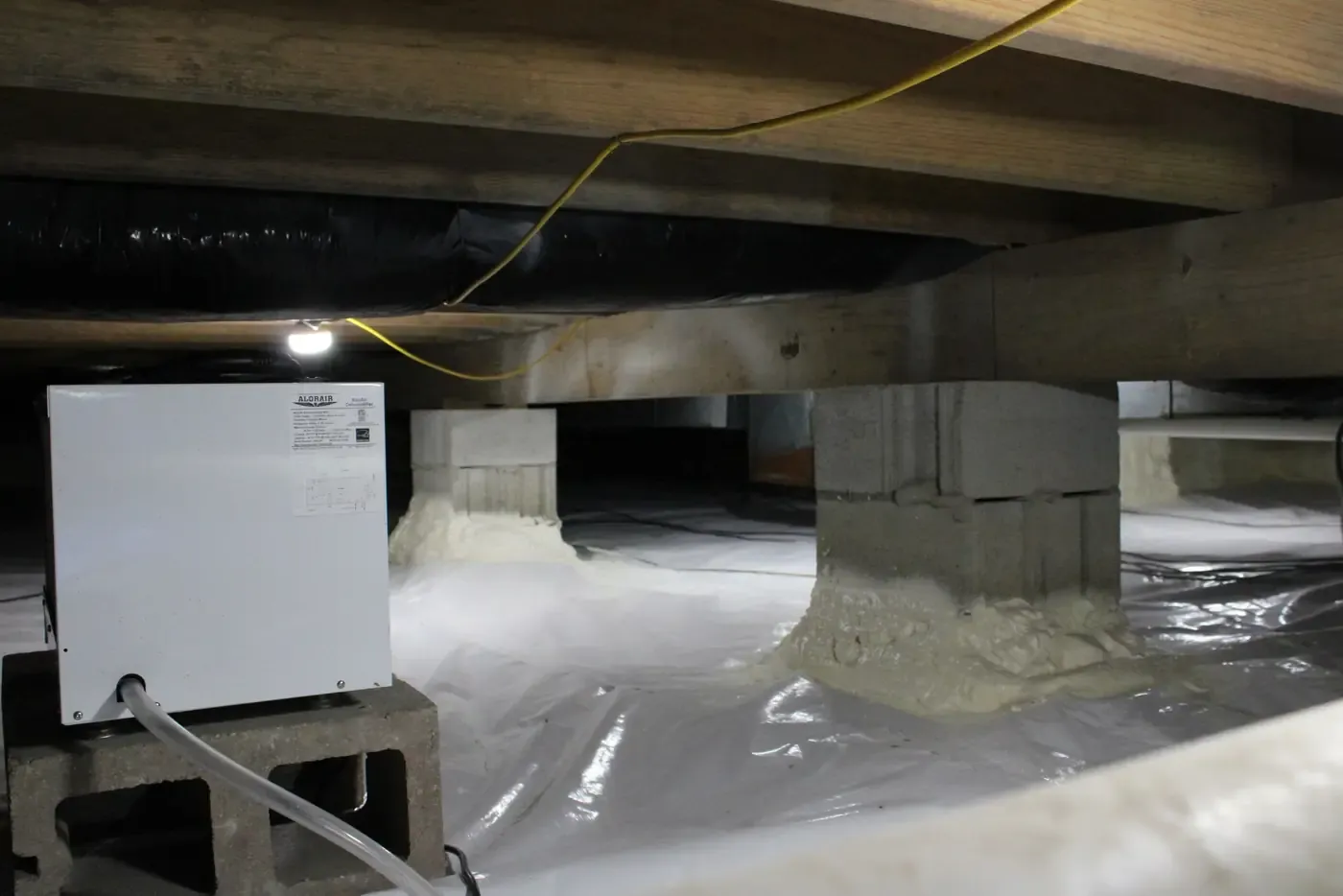
The ground is the biggest moisture source in most crawlspaces. We cover it with a continuous vapor barrier in 6.5 mil, 10 mil, or 18 mil, overlap and seal the seams, and seal it at piers and up the foundation walls. The goal is one continuous layer between the soil and the house.
- Moisture control
A sealed vapor barrier keeps soil moisture out of the crawl air, which helps protect wood framing and other building materials from humidity damage.
- Cleaner, more usable space
A sealed floor is easier to inspect and service and gives plumbing, ductwork, and wiring a drier place to live.
- Pest deterrence
Sealing the ground and closing openings removes easy entry points and gives pests less to work with.
Closed-cell spray foam at the walls and rim joist
Once the crawl is sealed from the outdoors, the insulation belongs at the perimeter. We spray closed-cell foam on the foundation walls and the rim joist. Closed-cell bonds to concrete and wood, air-seals the sill crack and rim edge, adds about R-6.5 to R-7 per inch, and at roughly 1.5 inches or more it also acts as a vapor retarder.
The rim joist is the band of lumber that sits on the foundation and carries the first floor. It is often the leakiest part of a crawl. Indiana is climate zone 5, where rim joists are commonly insulated to about R-20:
- Climate zones 1–4: minimum R-13 at the rim
- Climate zones 5–8 (including Central Indiana): minimum R-20 at the rim
If you look into your crawlspace and see bare wood above the foundation, or batts hanging loose in the rim bays, air is moving through that edge.
We use closed-cell here, not open-cell. Open-cell is vapor-open, and it is never our foam for Indiana exterior walls or foundation perimeters.
Dehumidifiers
Once we encapsulate your crawlspace, we can install a dehumidifier to hold humidity in a stable range through humid Indiana summers. That keeps the crawl drier, protects wood and fasteners, and helps the house above it stay more comfortable.
Insulation removal
Old fiberglass batts between floor joists often sag, fall, or hold moisture in a vented crawl. If you need old or damaged insulation removed from your crawlspace, we take it out before the new system goes in so the finished crawl starts clean.
Longer guides: crawlspace encapsulation in Central Indiana, rim joist insulation in Indiana basements, air sealing vs R-value in climate zone 5 Indiana, and crawlspace vs basement in Hamilton County.