
2026-08-31
Closed-cell vs open-cell spray foam in Indiana
By Hoosier Spray Foam
Which spray foam to use in Central Indiana homes, crawlspaces, attics, and pole barns. Closed-cell vs open-cell, R-value, moisture, and when blown-in insulation is the better fit.
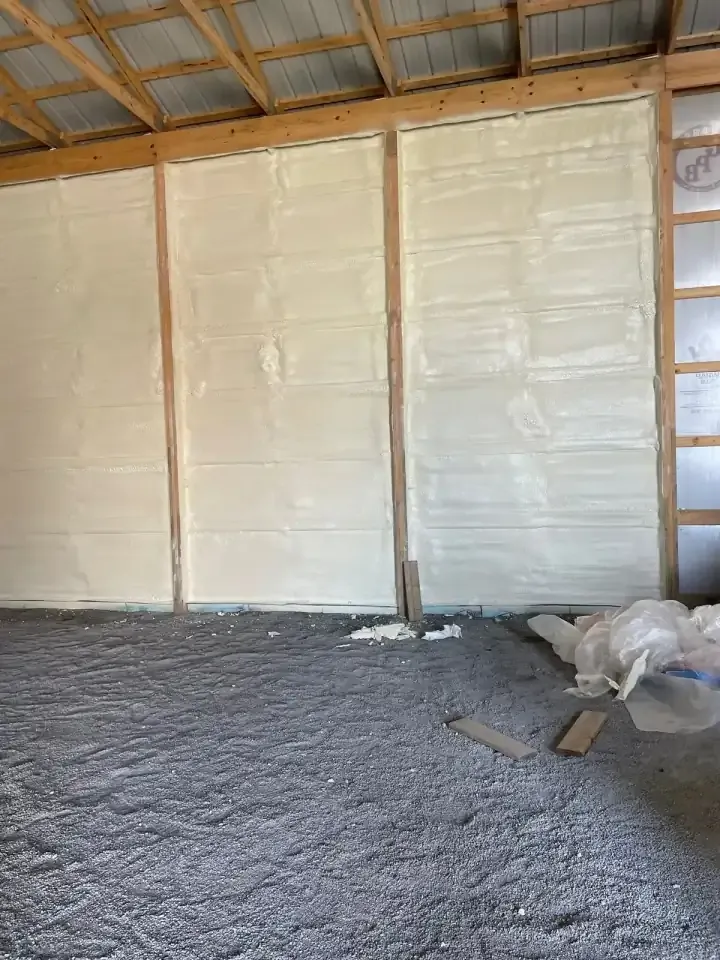
Closed-cell spray foam is usually the better choice in Central Indiana when you need air sealing, a moisture barrier, and high R-value in a tight space. Open-cell is the better choice when you want sound control and coverage in an attic or interior wall at a lower cost per inch. Many jobs here use both.
Hoosier Spray Foam installs spray foam and blown-in insulation for homes and buildings around Westfield, Carmel, Fishers, Noblesville, Zionsville, and the rest of Central Indiana. If you are deciding between products, the climate and the assembly matter more than the brand name on the tank.
Indiana weather is why the choice matters
Central Indiana sits in a mixed-humid climate: hot, sticky summers, cold winters, and a lot of moisture moving through the year. Insulation that only fills a cavity, without air sealing, still lets humid air into walls, crawlspaces, and attics.
Closed-cell foam expands into a dense layer (about R-7 per inch) and, at roughly 1.5 inches or more, acts as a vapor barrier. Open-cell is lighter, about R-3.5 to R-4 per inch, and stays vapor-open, so it is a poor match for damp crawlspaces or the underside of a metal pole-barn roof.
Closed-cell: where we use it
- Crawlspaces and rim joists. See crawlspace encapsulation.
- Basement walls. See basement insulation.
- Pole barn walls and roofs. See pole barn insulation.
- Thin, wet, or high-load spots where you cannot give up inches of space.
Open-cell: where we use it
Interior walls, some attics designed to dry, and retrofits where moisture is already controlled. If attic insulation is wet or contaminated, removal comes first. See attic insulation.
Exterior walls in Indiana: open-cell does not belong there
Central Indiana is IECC climate zone 5. The residential code used here (Indiana’s adoption of the IRC, vapor retarders in IRC R702.7) requires a vapor retarder on the warm-in-winter side of exterior wall assemblies in zones 5 through 8.
Closed-cell spray foam at enough thickness (about 1.5 inches, Class II, low perm) can be that vapor retarder and an air seal in one layer. Open-cell is vapor-open (often 10 perms or more). It does not qualify as the vapor retarder, and it does not keep winter indoor moisture off cold OSB or plywood sheathing.
That is why we do not put open-cell on exterior walls in Indiana. In this climate, open-cell in an exterior stud bay is a condensation risk and a code problem unless you add a separate, correctly placed vapor retarder — which defeats the reason people wanted foam in the wall. Closed-cell is the foam we use on exterior walls. Open-cell stays inside: interior walls, some ceilings, and assemblies that are designed to dry and are not the building’s weather shell.
Local amendments still rule. Hamilton County and nearby towns inspect to the Indiana codes in force. We spec foam so the wall can pass inspection and stay dry, not so the cheapest board-foot wins.
When blown-in is the better fit
Blown-in cellulose or fiberglass is often right for an attic floor after air sealing, or a pole-barn ceiling when walls are foamed. Spec the mix from the building.
Next step
Call 317.210.2931 or request an estimate. Weekdays 8am–5pm, 15001 Shelborne Road, Westfield.
Ready for a local look at your building?
Call 317.210.2931 or request an estimate. Weekdays 8am–5pm, 15001 Shelborne Road, Westfield, IN 46074.