
2026-09-01
Closed-cell spray foam R-value for Indiana pole barns
By Hoosier Spray Foam
Closed-cell is about R-7 per inch on Indiana pole barn walls and roofs. Open-cell is about R-3.5–R-4 and a poor metal-building default in climate zone 5.
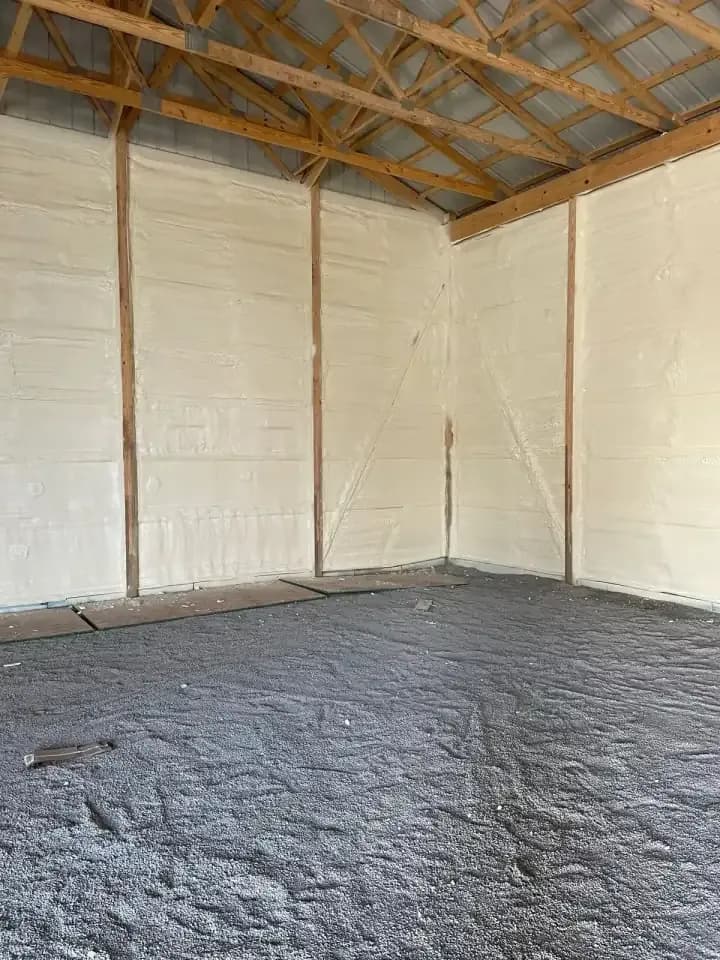
Closed-cell spray foam is about R-7 per inch on Indiana pole barn walls and roofs. Open-cell is about R-3.5 to R-4 per inch and stays vapor-open, so it is a bad metal-building default. Twice the open-cell thickness can chase R-value and still leave no vapor barrier on the steel.
Hoosier Spray Foam installs this on shops and barns around Westfield, Zionsville, rural Boone County, and the rest of our service area. The closed-cell vs open-cell article compares products across house assemblies. This page stays on metal buildings and R-value per inch.
What does R-7 per inch mean on a pole barn wall?
R-value is resistance to heat flow. Per inch matters on a barn because girts and purlins only give you a few inches before you bury the steel or eat the bay.
At about R-7 per inch, 1.5 inches of closed-cell is about R-10 to R-11. Two inches is about R-14. Three inches is about R-21. Those are nominal product figures, not a lab certificate for every brand and every winter morning. Thickness still has to be continuous. A 2-inch spec with holidays at the eave is not R-14.
Open-cell at R-3.5 to R-4 per inch needs about twice the inches for the same R. On a metal girt you often do not have twice the inches. On a roof, extra inches of vapor-open foam still leave you without the vapor control closed-cell provides at about 1.5 inches.
We do not treat R-7 as a marketing slogan. It is the closed-cell figure we already publish on the pole barns page and the number we use in estimates.
Why is R-value not enough by itself on metal?
A barn fails on condensation as often as it fails on heat loss. Steel is cold. Indoor air is wet. Insulation that is not a vapor retarder, and not bonded to the panel, can show a decent average R and still drip.
Closed-cell at about 1.5 inches or more acts as a vapor barrier and an air seal. That is why the same product shows up on exterior walls in climate zone 5 and on pole barn steel. Open-cell does not pick up that vapor-retarder role. It is the wrong default even if someone offers to “spray it thicker for the same R.”
Air sealing is the other half. Panel laps and screw lines leak. Heat loss through leaks does not show up as a clean R-per-inch on a data sheet. Closed-cell expanding into those gaps is why a foamed barn feels tighter than the R number alone predicts.
How does open-cell compare if I only care about cost per R?
Open-cell usually costs less per board foot. Board feet are inches times square feet, so a thicker open-cell job can erase the savings and still lose on vapor. On a house interior wall, that trade can be rational. On a metal roof in Tipton or Clinton County, it is a wet-roof trade.
A fair comparison for a barn is not “cost per inch.” It is cost to get a continuous air seal, a useful R, and vapor control on the steel. Closed-cell wins that comparison in this climate. That is why we call open-cell a bad metal-building default — not because open-cell is useless in every building, but because metal plus zone 5 is the wrong place to use it as the shell.
Pole barn spray foam in rural Indiana covers board-foot math and roof-versus-wall decisions. Spray foam cost covers how we estimate without fake per-square-foot quotes.
What thickness do Indiana pole barns usually need?
There is no single code table we invent for “pole barn R-value in Indiana.” Agricultural and post-frame buildings are not always permitted like a house. When a shop is permitted as conditioned space, the inspector and the energy code in force locally still matter. We spec thickness from how the building will be used:
- Storage that will stay cold needs little or no foam.
- A shop you will heat on winter weekends needs enough closed-cell on the heated shell to stop condensation and take the edge off the bill.
- A finished, daily-use shop or an office bay needs more inches and a complete air seal, sometimes with a ceiling plane and blown-in above.
We would rather say that on site than publish a fake “code requires X inches on every barn” line. Bring the use, the heater type, and photos of the steel.
Does closed-cell add strength to the metal?
Closed-cell bonded to the panel stiffens light-gauge steel. Our pole barns page notes the shear-strength benefit of foam applied to the metal. That is a bonus, not the reason to choose the product. Condensation control and R-per-inch are the reasons. Do not buy foam as a tornado product. Buy it as the right insulation for metal in this climate.
How should I read two bids that show different R-values?
Ask each contractor:
- Closed-cell or open-cell?
- Inches on walls and inches on the roof?
- R-per-inch they are using, and whether it matches the product data sheet.
- Whether the foam touches the metal.
- Whether liner panels or old foil stay in place.
If one bid is “R-20 open-cell” and the other is “2 inches closed-cell,” they are not the same job. The first may be five inches of vapor-open foam. The second is a vapor-retarding air seal at about R-14. Different physics. Hiring a spray foam contractor is the checklist.
Next step
Call 317.210.2931 or request an estimate. Weekdays 8am–5pm, 15001 Shelborne Road, Westfield. Rural Boone, Clinton, Tipton, Carroll, Cass, Miami, Grant, and Hamilton County shops included.
Ready for a local look at your building?
Call 317.210.2931 or request an estimate. Weekdays 8am–5pm, 15001 Shelborne Road, Westfield, IN 46074.