
2026-09-01
Hiring a spray foam contractor in Indiana
By Hoosier Spray Foam
What to ask a Central Indiana spray foam contractor — insurance, photos, product and thickness, and why box-store DIY kits fail on rims, crawls, and pole barns.
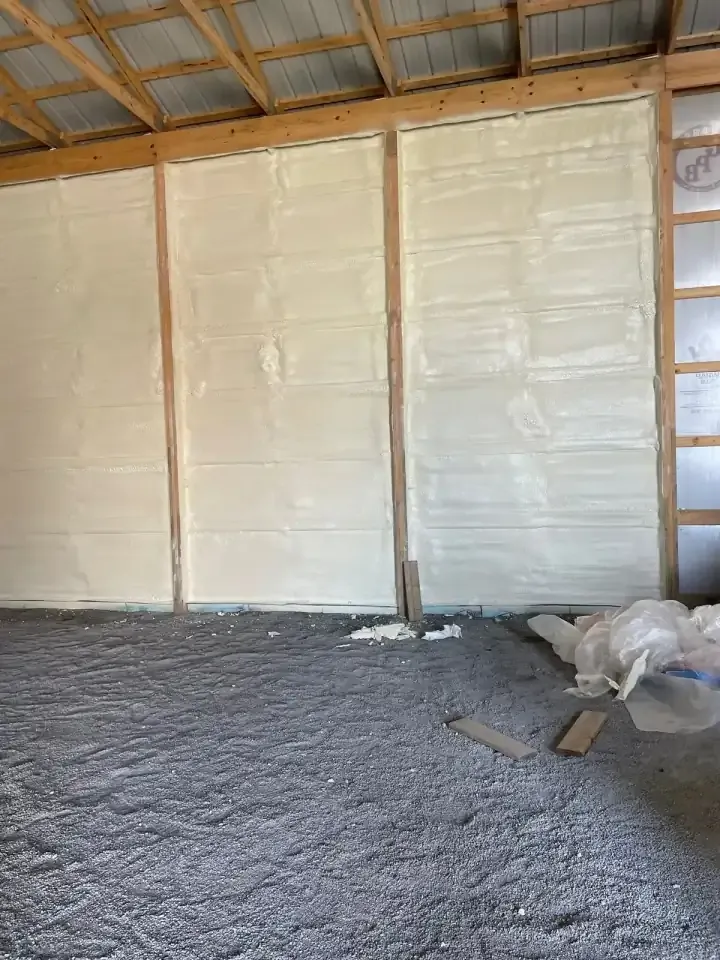
Hire a spray foam contractor who will name the product, the thickness, and the assembly — then show insurance and photos of similar Indiana work. Ask how they handle climate zone 5 exterior walls, rims, crawls, and metal. DIY two-part kits fail on yield, ratio, adhesion, and fire-safety detailing. The cheap kit is often the expensive redo.
Hoosier Spray Foam is a local shop at 15001 Shelborne Road, Westfield. We expect you to ask us the same questions we list here. This is not a competitor takedown. It is the conversation we want every Carmel, Fishers, Noblesville, and rural Boone County owner to have before anyone sprays.
What should I ask before I sign a foam estimate?
- Closed-cell or open-cell, and where? Exterior walls in Indiana should not get open-cell. That is the flagship climate-zone article. Metal barns should not get open-cell as the shell. Pole barn R-value explains why.
- Thickness on each surface? “Foam the crawl” is not a spec. Inches on the rim, inches on the wall, mil of the liner, and whether a dehumidifier is included are the spec.
- Board feet and square feet. Foam is sold in board feet. Liners and blown-in are not. Cost variables show how those numbers move.
- Who is on site? Ask who sprays, who owns the company, and how to reach someone after the truck leaves.
- Insurance. Ask for a current certificate. General liability matters when foam is on someone else’s house. If they have employees, ask about workers’ compensation. You are allowed to have the certificate sent to you or your agent.
- Photos of similar assemblies. A gallery of random white foam is not enough. Ask for a rim, a crawl liner detail, a pole barn roof, or an exterior wall — whichever you are buying. Our job photos are public for that reason.
- Prep, occupancy, and ignition or thermal barriers. Foam has processing and finishing rules. Ask what you must do the day of the job and what still has to be covered after the foam cures.
- License and permit. Not every foam job needs a permit. When it does, ask who pulls it and which code version the spec follows. We do not invent section numbers to sound official. IRC R702.7 is the vapor-retarder section we will talk about on exterior walls because that is the one that applies.
Write the answers on the bid. If two bids cannot be lined up on product, inches, and surfaces, they are not comparable.
Why do DIY spray foam kits fail?
Kits look like they solve a rim or a small barn wall. They usually fail in the same ways:
- Off-ratio foam. The two parts have to meet at the right temperature and ratio. A cold garage in January in Tipton County is a hard place to keep a kit in spec. Off-ratio foam can stay soft, shrink, or crumble.
- Yield. The advertised board feet assume perfect conditions. Real yield on a rim with leaks and cold concrete is lower. People run out halfway around the house.
- Adhesion and thickness. Missed sill cracks, thin corners, and foam that falls off dusty block are common. The leak you cared about is still there.
- Re-entry and fire-safety finishing. Professional jobs come with product rules for occupancy and for covering foam where code or the manufacturer requires a barrier. A kit in a basement does not erase those rules.
- Removal. Bad foam on wood and concrete is miserable to take off. The “save money on the rim” project becomes a removal line on our estimate.
We will still foam a house after a kit. We would rather foam it once. Small touch-ups are not the same as a first-time rim or a metal roof.
What photos and details actually prove competence?
Look for:
- Continuous foam at the sill, not only pretty bays in the middle of the rim.
- Crawl liners run up the wall and taped at piers, not a tarp on the dirt.
- Pole barn foam that touches the steel, including eaves and truss heels.
- Exterior-wall foam that is closed-cell, with a thickness you can see.
Ask when the photo was taken and whether it is their crew. Ask what they would do differently on your house. A contractor who can talk about crawl vs basement in a Hamilton County split-level is paying attention.
How do I check that they are really local?
A Westfield address you can visit during Monday–Friday 8am–5pm is a start. Ours is 15001 Shelborne Road. Call 317.210.2931 and see who answers. Ask which counties they actually drive — Boone, Hamilton, Tipton, Howard, Clinton, Miami, Hancock, Madison, Hendricks, Carroll, Grant, Cass — and whether your rural lane is a problem in thaw season.
Online ads can look local. The estimate visit is the test. If nobody will crawl the hatch or look at the barn steel, keep calling.
What should be in writing?
- Scope by area (rim, crawl, basement walls, barn walls, barn roof).
- Product type and target thickness.
- Exclusions (standing water, electrical, old insulation removal).
- Price basis (board feet, liner square feet, dehumidifier allowance).
- Schedule window and what happens if weather slips.
- Warranty in plain language — what is covered, for how long, and what voids it.
Use the estimate form on our contact page. You can request work there without guessing email.
Next step
Call 317.210.2931 or request an estimate. Weekdays 8am–5pm, 15001 Shelborne Road, Westfield.
Ready for a local look at your building?
Call 317.210.2931 or request an estimate. Weekdays 8am–5pm, 15001 Shelborne Road, Westfield, IN 46074.