
2026-09-01
Crawlspace vs basement insulation in Hamilton County
By Hoosier Spray Foam
How to choose encapsulation versus basement-wall and rim-joist foam in Hamilton County and north Indianapolis homes — including mixed foundations in Carmel, Fishers, and Noblesville.
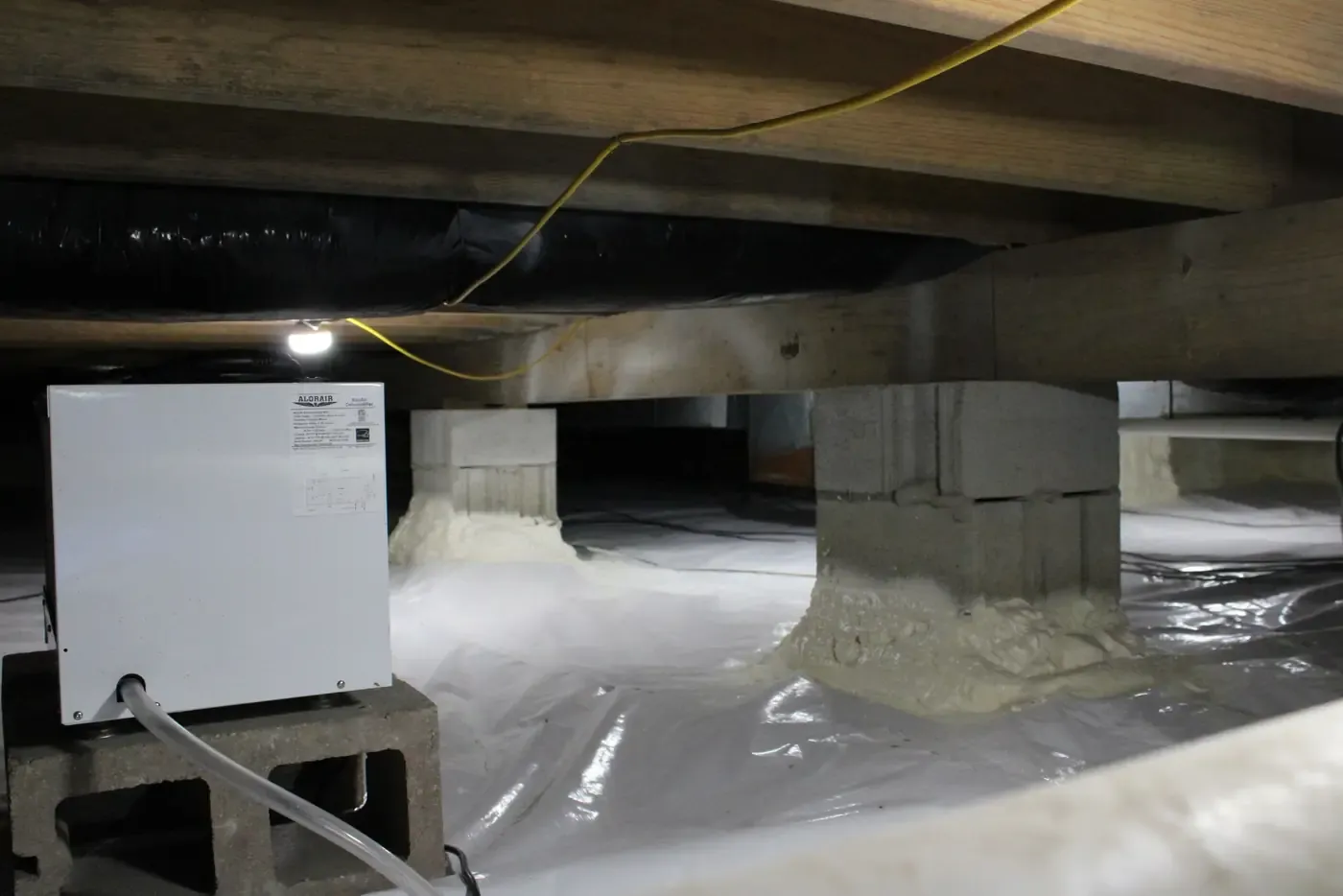
If the house has a dirt crawl, encapsulate it: liner, sealed seams, closed-cell at the rim, and a dehumidifier when humidity still will not hold. If it has a full basement, foam the rim and decide on the walls. Many Hamilton County homes have both, and each area gets the path that matches the foundation.
Hoosier Spray Foam is in Westfield and works Carmel, Fishers, Noblesville, and Zionsville every week. This is a foundation article. We are not using it to sell attic packages. The question is which insulation and moisture path belongs under the first floor.
How do I tell crawlspace work from basement work?
A crawlspace is a shallow, usually unfinished volume with soil or a thin slab, accessed by a hatch or skirt door. The moisture source is the ground and the vents. The system is encapsulation: vapor barrier (6.5, 10, or 18 mil), rim foam, wall treatment as specified, dehumidifier when needed.
A basement is a full-height story, finished or not, with concrete or block walls. The moisture story is walls, floor, and the rim. The system is basement and rim-joist foam: closed-cell at the band, and closed-cell on walls when those walls are part of the heat loss and vapor load.
If you can stand, it is a basement path. If you crawl on dirt, it is an encapsulation path. If you can stand in one part and crawl in another, it is both.
What does a typical Hamilton County house actually have?
North of Indianapolis the stock is mixed:
- 1990s–2010s Fishers and Carmel subdivisions with a basement under the house and a shallow crawl or framed garage edge.
- Noblesville houses near the square with a partial cellar and a crawl under a later addition.
- Westfield builds with a full basement and a porch or sunroom on piers.
- Zionsville and rural Boone lots with a basement plus a crawl under a wing, or a house on a crawl entirely.
The mistake is to treat the whole footprint as whichever space you entered first. A finished basement with a perfect rim can still push humid air from an open dirt crawl under the family-room addition. A beautiful liner in the crawl does not air-seal a bare band in the basement.
We walk both. The estimate lists crawl and basement as separate scopes when they are separate assemblies.
Which path if the floors are cold but the basement feels fine?
Cold first-floor rooms over a garage, porch, or addition are often a crawl or cantilever problem, not a basement-wall problem. Encapsulation or closed-cell at that floor edge comes first. Rim foam in the main basement still helps the perimeter, but it will not warm a room that sits over open dirt.
Cold basement rooms with warm upstairs floors are a wall and rim problem. Foam the band. Add wall foam if the block is bare and the space is used.
Musty first-floor air with a “dry” basement often traces to a vented crawl you have not looked at. Open the hatch.
How do vapor barriers differ in the two assemblies?
In a crawl, the vapor barrier is a sheet on the soil, run up the walls, sealed at piers. Thickness is 6.5, 10, or 18 mil depending on traffic and grade. See the encapsulation guide.
In a basement, the vapor control is usually the closed-cell itself on walls and rim — about 1.5 inches or more as a vapor barrier — not a sheet on a finished floor. A basement slab can still get a vapor story in new work or a floor / under-slab conversation, but that is not the typical remodel encapsulation.
Do not staple crawl plastic onto basement living walls and call it done. Do not skip the crawl liner because the basement already has foam.
What about mixed humidity equipment?
A basement dehumidifier does not dry a vented crawl. A crawl dehumidifier does not replace rim foam in the basement. After encapsulation, a crawl-specific unit is common. After basement-wall foam, the existing basement dehumidifier or HVAC often runs less because less vapor is coming through the walls.
We spec equipment after the air and soil paths are closed. Running a unit in an open crawl is a utility bill, not a system.
Which product — closed-cell, open-cell, or blown-in?
Closed-cell is the foam for rims, crawl walls, and basement walls in this climate. Open-cell does not belong on those exterior, wet assemblies. Why open-cell stays off exterior walls is the climate-zone explanation.
Blown-in is not a crawl encapsulation and not a basement-wall product. It can still be the right material in other parts of the same house. Blown-in vs spray foam is the comparison.
How should a Carmel or Westfield owner start the estimate?
Tell us whether you have a hatch, a walk-down basement, or both. Mention additions, sunrooms, and garages. Photos of the rim, the dirt (or old plastic), and the basement walls are enough to start. We will say which path — or both — before we talk board feet.
Cost variables are in how much spray foam costs. Service work is scheduled from 15001 Shelborne Road, Westfield, Monday–Friday 8am–5pm.
Next step
Call 317.210.2931 or request an estimate.
Ready for a local look at your building?
Call 317.210.2931 or request an estimate. Weekdays 8am–5pm, 15001 Shelborne Road, Westfield, IN 46074.