
2026-09-01
Why open-cell spray foam should not go on exterior walls in Indiana
By Hoosier Spray Foam
Indiana is climate zone 5. Open-cell is vapor-open and does not meet the warm-side vapor retarder role in IRC R702.7. Closed-cell is the foam we use on exterior walls.
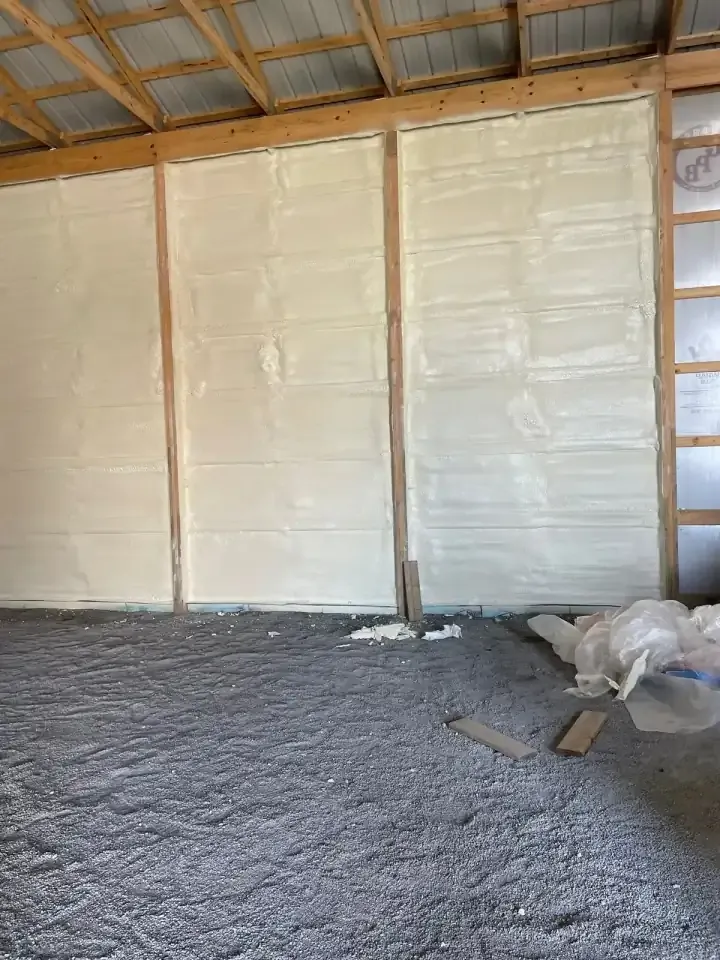
Open-cell spray foam should not go in exterior wall cavities in Indiana. Central Indiana is IECC climate zone 5. IRC R702.7 calls for a vapor retarder on the warm-in-winter side of framed exterior walls. Closed-cell at enough thickness can be that layer. Open-cell stays vapor-open and leaves winter moisture on cold sheathing.
Hoosier Spray Foam is based at 15001 Shelborne Road in Westfield. We install closed-cell on exterior walls for homes in Carmel, Fishers, Noblesville, Zionsville, and the rest of Hamilton and Boone counties. This article is the deep dive. Our closed-cell vs open-cell overview sketches the product split. Here we stay on the wall assembly.
Why does climate zone 5 change the exterior-wall foam choice?
Climate zone 5 is a heating-dominated, mixed-humid climate. Westfield winters get cold enough that interior air holds more moisture than the outdoor air. That moisture wants to move outward through walls. If it hits a cold surface — OSB or plywood sheathing just behind vinyl, brick, or fiber-cement — it can condense.
Insulation that only fills a stud bay, without controlling air and vapor, still lets humid air reach those cold surfaces. Spray foam on an exterior wall has to air-seal the cavity and manage vapor. Only one of the two common foams does both in zone 5.
What does IRC R702.7 actually require on Indiana exterior walls?
IRC R702.7 is the vapor-retarder section of the International Residential Code. Indiana adopts the IRC, then applies state and local amendments. In climate zones 5 through 8, the rule requires a vapor retarder on the interior — the warm-in-winter side — of framed exterior walls.
The version on the inspector’s desk in Hamilton County, Noblesville, Carmel, or Westfield is the one that matters. The principle does not change: the warm-side layer has to slow winter vapor enough that the sheathing stays dry.
Closed-cell spray foam at enough thickness (about 1.5 inches in common product data, Class II, low perm) can be that vapor retarder and an air seal in one layer. Open-cell is vapor-open — often 10 perms or more. It does not qualify as the vapor retarder and does not keep winter indoor moisture off cold sheathing. Adding a separate interior retarder after open-cell is already in the bay can solve the paperwork and still leave a wet wall.
Why is open-cell a condensation risk in an Indiana stud bay?
Open-cell foam is light, spongy, and good at filling odd cavities. It is also air-permeable compared with closed-cell and highly vapor-permeable. In an interior partition, that is often fine. In an exterior 2x4 or 2x6 bay in Fishers or Zionsville, the winter path is:
- Indoor air is humid from showers, cooking, and people.
- That air leaks or diffuses into the stud bay.
- The sheathing is cold because it faces January air.
- Moisture condenses or accumulates in the OSB or on the back of the foam.
Open-cell does not block that path the way closed-cell does. It can even hold liquid water. A wall that looks “fully foamed” from the inside can still be a wet wall.
Closed-cell expands into a dense layer at about R-7 per inch. At roughly 1.5 inches or more it acts as a vapor barrier and an air seal. The warm-side surface of the foam stays closer to indoor conditions. The sheathing is not the first cold surface the indoor moisture meets.
Can I add a plastic sheet or paint and still use open-cell on the exterior wall?
Sometimes people ask for open-cell because it costs less per inch, then offer to “just add visqueen” or a vapor-retarder paint. That is not how we spec exterior walls in this climate.
A separate retarder has to be continuous, on the correct side, and compatible with how the wall dries. A sheet that is cut up by boxes, poorly taped, or placed on the wrong side can trap moisture. Paint-on retarders vary by product and film thickness. None of that is a reason to put the wrong foam in the bay.
If you still need a separate retarder after the foam is in, you have usually defeated the reason you wanted foam in the wall. Closed-cell is the foam we use on exterior walls. Open-cell stays inside: interior walls, some ceilings, and assemblies that are designed to dry and are not the building’s weather shell.
Where does open-cell still belong in a Central Indiana house?
Open-cell is not a bad product. It is a bad exterior-wall default in zone 5.
We still use open-cell where moisture is already controlled and the assembly is not the weather shell — interior walls for sound, some ceilings, and other interior cavities. The closed-cell vs open-cell guide covers that mix. We will not spray open-cell on exterior studs in Westfield, Carmel, or rural Boone County just to win a board-foot price. See how spray foam cost is estimated.
How do exterior walls differ from crawlspaces, rim joists, and pole barns?
The same climate logic shows up in other assemblies, with different details.
- Crawlspaces and rim joists sit on cool concrete and outdoor air leaks. Closed-cell is the usual foam. See crawlspace encapsulation in Central Indiana and rim joist insulation.
- Metal pole barns have a condensation problem on the steel. Closed-cell goes to the metal. Open-cell is a poor metal-building default. See pole barn spray foam and closed-cell R-value on Indiana pole barns.
- A crawlspace vs basement decision is about the foundation type, not about putting open-cell on the above-grade walls.
Exterior walls are the case where code language and climate line up in the same direction: warm-side vapor control in zone 5.
What should a homeowner in Hamilton County ask before anyone foams a wall?
Ask what product goes in the exterior bays, at what thickness, and how that layer meets the vapor-retarder role in IRC R702.7. Ask to see photos of similar zone 5 walls, not only attics or interior sound walls. Ask who carries the insurance and who will be on site. Hiring a spray foam contractor in Indiana lists the rest of that conversation.
If a bid uses open-cell on the exterior wall as the money-saving line item, treat that as a reason to pause — not as a bargain. Local amendments still rule. We spec foam so the wall can pass inspection and stay dry.
Next step
Call 317.210.2931 or request an estimate. Weekdays 8am–5pm, 15001 Shelborne Road, Westfield. We serve Boone, Hamilton, Tipton, Howard, Clinton, Miami, Hancock, Madison, Hendricks, Carroll, Grant, and Cass counties.
Ready for a local look at your building?
Call 317.210.2931 or request an estimate. Weekdays 8am–5pm, 15001 Shelborne Road, Westfield, IN 46074.