
2026-09-01
How much does spray foam cost in Central Indiana
By Hoosier Spray Foam
How spray foam is priced in Central Indiana — board feet, open-cell vs closed-cell, thickness, access, and why a crawl and a pole barn are different jobs. Education, not fake quotes.
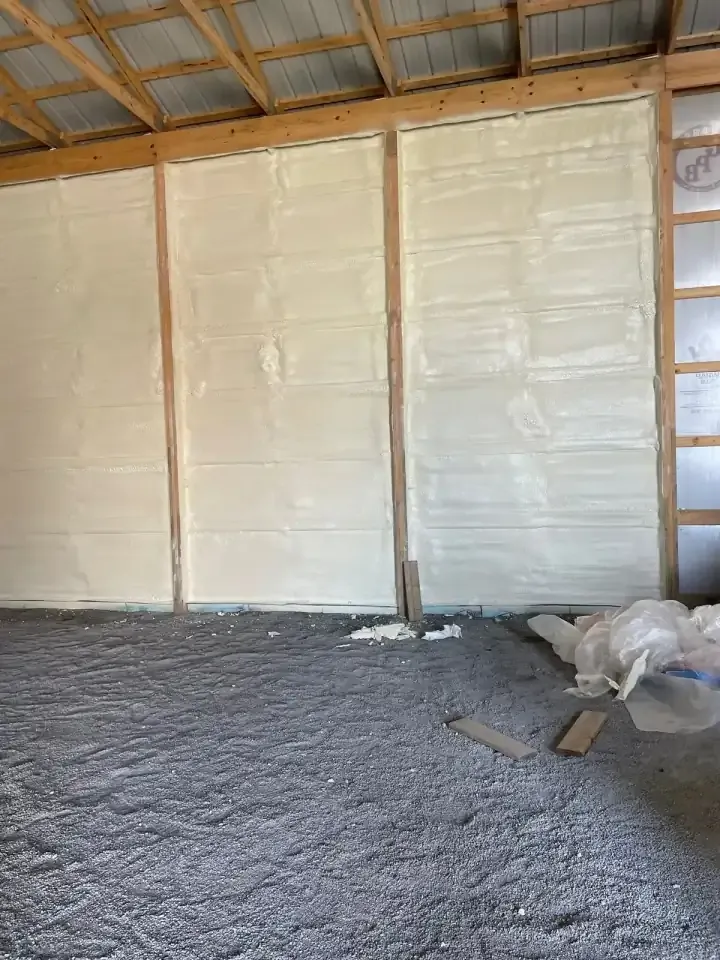
Spray foam in Central Indiana is priced by the board foot, then adjusted for product, thickness, access, and extras such as a liner or barn roof. There is no honest price-per-square-foot that covers a Westfield crawl and a Boone County pole barn. We will not publish fake quotes. We will show you how the number is built.
Hoosier Spray Foam estimates from 15001 Shelborne Road, Westfield. Call 317.210.2931 or use the estimate form. Hours are Monday–Friday 8am–5pm. This article is the cost education. Hiring a contractor is the questions to ask once you have numbers.
What is a board foot, and why do foam bids use it?
One board foot is one square foot of foam one inch thick. Two inches on 1,000 square feet is 2,000 board feet. The same wall at three inches is 3,000 board feet. That is why “foam my barn” and “foam my rim” cannot share a square-foot price. The inches are the job.
A rim around a typical Hamilton County basement might be a few hundred square feet of surface and a few inches thick. A 40-by-60 barn roof is thousands of square feet. Same product, different board feet by an order of magnitude. Pole barn board-foot math walks a barn example.
When you read a bid, look for:
- Square feet of each surface.
- Inches on each surface.
- Board feet (square feet × inches).
- Open-cell or closed-cell (they are not the same price per board foot).
If a bid only says “job total” with no board feet, ask for the breakdown. If two totals are far apart, the board feet or the product usually explain it.
Why does closed-cell cost more per board foot than open-cell?
Closed-cell uses more material per inch, yields a higher R-value (about R-7 per inch vs about R-3.5–R-4), and can be the vapor retarder at about 1.5 inches. Open-cell is cheaper per board foot and takes more inches to reach the same R.
The cheap inch is not the cheap assembly when the cheap inch is the wrong product. Open-cell on an Indiana exterior wall is a climate-zone and IRC R702.7 problem, not a bargain. See why open-cell should not go on exterior walls. Open-cell on metal is a condensation problem. See closed-cell R-value on pole barns.
A fair cost question is: what does it cost to get the right assembly? Not: what is the lowest number next to the word foam.
How do thickness and access change the price?
Thickness is linear in board feet. Access is not.
Hard access — a tight crawl in Noblesville, a barn loft, a rim buried in storage, a rural lane that will not take the rig in March — adds labor time. Easy access — an empty new-construction wall, a clean shop — lowers it. Winter heat for the equipment, masking a finished basement, and working around a homeowner’s schedule all show up as labor, not as extra inches.
We would rather see the space than guess from a phone call. Photos help. A site visit is better for crawls and barns.
Why is a crawlspace a different ticket than a pole barn?
A crawlspace encapsulation is rarely “just foam.” The ticket often includes:
- Old insulation removal.
- 6.5, 10, or 18 mil liner by the square foot, not the board foot.
- Sealing at piers and walls.
- Rim foam in board feet.
- A dehumidifier as a piece of equipment, not as foam.
A pole barn is mostly foam board feet on steel, plus travel and setup. An under-slab or floor line is extra if it exists. Comparing a crawl total to a barn total without looking at those lines is how people conclude foam is “randomly priced.”
A basement rim is often the smallest of the three — until you add basement walls. Crawl vs basement is the scope split for Hamilton County houses that have both.
What variables should I expect on a Central Indiana estimate?
- Product: closed-cell vs open-cell vs a mix vs blown-in on another plane.
- Thickness: inches per surface, not a house-wide average.
- Area: rim only, walls, roof, crawl liner, barn lean-to.
- Prep: removal, masking, blocking, pest or moisture issues that are not foam.
- Access: hatch size, ceiling height, rural drive, occupied house.
- Equipment: dehumidifier, not included unless listed.
- Travel: Westfield to Carmel is not the same day as a Cass County farm, but we serve both.
We serve Boone, Hamilton, Tipton, Howard, Clinton, Miami, Hancock, Madison, Hendricks, Carroll, Grant, and Cass counties. Distance alone does not decide the bid. Scope does.
Why won’t you publish a price list?
A public number becomes a fake quote the moment someone has a different thickness, a dirt crawl, or a roof we have not measured. It also becomes a weapon against any contractor who is specifying the right product. We would rather be compared on board feet and assemblies than win a race to a website number.
What we will do is put the math on your estimate and walk it. If another bid is lower, we will help you see whether they used open-cell, fewer inches, or skipped the liner.
How should I use this when I call?
Have a rough size (basement perimeter, barn footprint and wall height, crawl hatch location). Know whether you want walls, roof, or both on a barn. Mention old insulation and standing water. We will tell you what we need to see.
Finishing the job still uses the same contact path as the rest of the site: phone, or the estimate form on Contact and Free estimate.
Next step
Call 317.210.2931 or request an estimate. Weekdays 8am–5pm, 15001 Shelborne Road, Westfield.
Ready for a local look at your building?
Call 317.210.2931 or request an estimate. Weekdays 8am–5pm, 15001 Shelborne Road, Westfield, IN 46074.