
2026-09-01
Crawlspace encapsulation in Central Indiana
By Hoosier Spray Foam
How we encapsulate crawlspaces around Westfield and Hamilton County — moisture, 6.5 vs 10 vs 18 mil vapor barriers, rim joists, and when a dehumidifier belongs in the system.
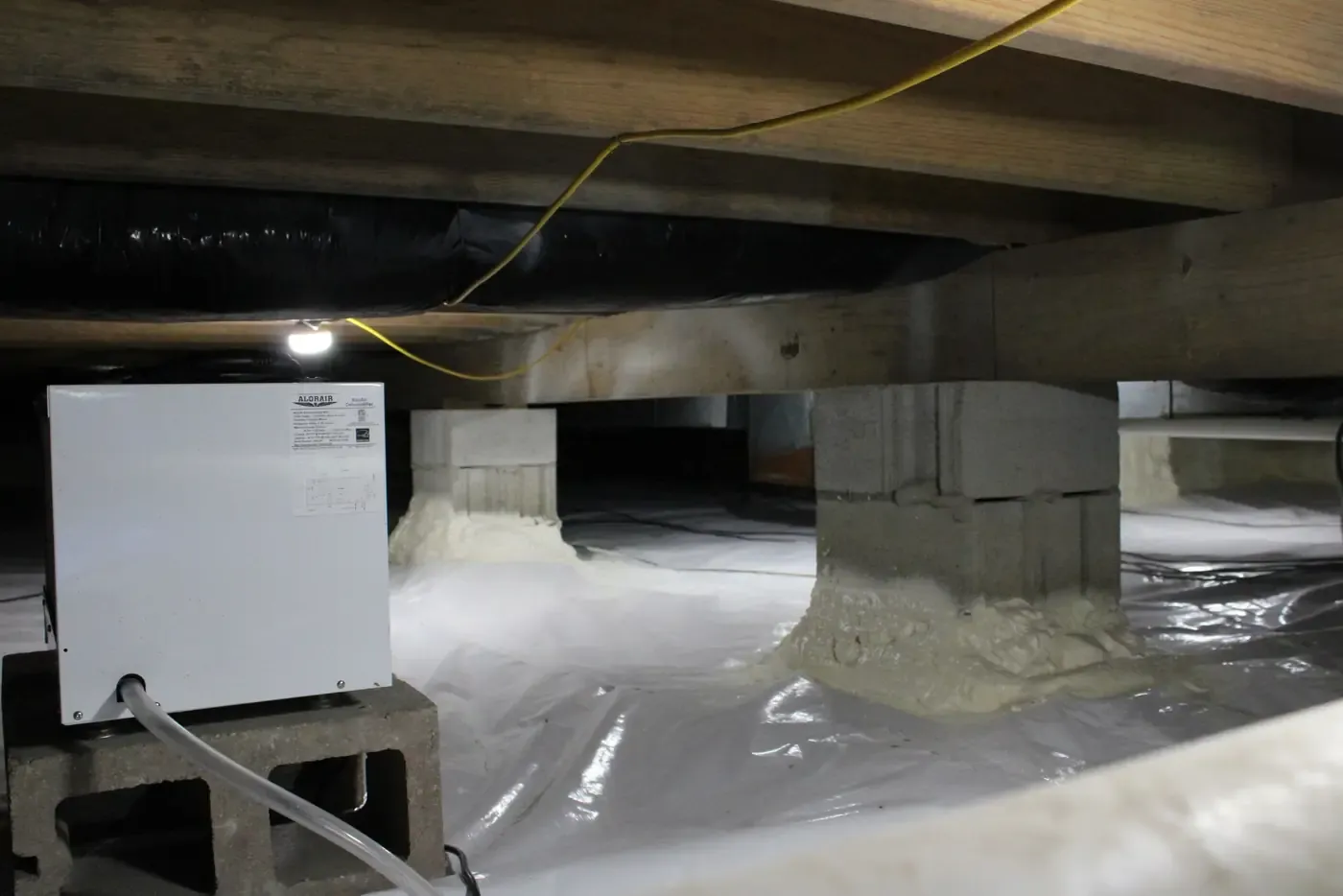
A Central Indiana crawlspace needs a sealed ground liner, closed-cell foam where the foundation leaks air, and a plan for leftover humidity. We install 6.5, 10, or 18 mil vapor barriers, foam the rim and walls as the job requires, and add a dehumidifier when the encapsulated space still cannot hold a stable humidity on its own.
Hoosier Spray Foam works crawlspaces from Westfield, Carmel, Fishers, Noblesville, and Zionsville out through Boone, Hancock, Hendricks, and the rural counties we serve. This is not an attic article. The work is under the floor, where Indiana’s mixed-humid climate and cool soil keep feeding moisture into the house if the crawl stays open.
Why do Central Indiana crawlspaces stay wet?
A vented or open crawlspace is connected to outdoor air and to damp soil. In Hamilton County that means humid summers, cold winters, and a lot of moisture moving through the year. Soil under the house evaporates water. Outdoor air comes in through vents, rim gaps, and utility penetrations. That air then stacks up into the living space.
Floors over an open crawl feel cold in January. In July the same crawl can push humid air into the first floor. Insulation that only hangs from the joists, without a sealed liner and air seal, still leaves the dirt and the vents in charge.
Encapsulation changes the job of the crawl. The ground gets a continuous liner. The walls and rim get air sealing. The crawl becomes a conditioned or semi-conditioned space instead of an outdoor room under the house. Details live on our crawlspace encapsulation service page.
What does a complete encapsulation include?
A typical Central Indiana encapsulation is a system, not a single product:
- Clean-out and insulation removal when old material is damaged, fallen, or in the way of a liner.
- A polyethylene vapor barrier on the floor, run up the walls, and sealed at seams, piers, and penetrations.
- Closed-cell spray foam at the rim joist and, when specified, on foundation walls.
- Mechanical work as needed — a sealed access, isolated vents, and a dehumidifier when humidity still will not stay in range.
We do not treat “plastic on the dirt” as a finished crawl. Seams that are not taped, walls that are not tied in, and a rim that still leaks outdoor air will keep the house connected to the soil.
Which vapor barrier mil should I choose — 6.5, 10, or 18?
Mil is thickness. A higher mil liner is tougher under knees, toolboxes, and future service work. It is not a different physics. All three products we install — 6.5 mil, 10 mil, and 18 mil — are there to stop soil moisture from evaporating into the crawl. The difference is durability and how the crawl will be used.
6.5 mil is the lighter liner. It can be the right fit on a dry, rarely entered crawl with a smooth grade and few piers, when the budget needs to stay on foam and detailing instead of a heavier sheet. It still has to be sealed. A thin liner with open seams is not a barrier.
10 mil is the middle of the range we install most often in Westfield and Carmel homes. It handles occasional access — HVAC techs, plumbers, future owners — better than a light sheet. For many Hamilton County houses this is the practical default.
18 mil is the heavy liner. We use it when the crawl is a storage path, the grade is rocky, there are many piers and transitions, or the owner wants a floor they can crawl for decades without punching holes. Rural properties in Boone, Clinton, or Tipton counties with rough dirt and more traffic often land here.
No mil number replaces workmanship. An 18 mil sheet that stops short of the wall, or a 10 mil sheet that is not sealed at the pier pads, still leaks soil moisture. Ask to see how seams, walls, and penetrations are detailed — not only the mil stamp on the roll.
When is a crawlspace dehumidifier needed?
Foam and a liner cut the two big moisture sources: outdoor air and bare soil. They do not always bring humidity into a stable range by themselves. A dehumidifier is the mechanical piece that holds the encapsulated crawl at a target humidity after the building leaks are closed.
We recommend a unit when:
- Summer humidity in the finished crawl still runs high after encapsulation.
- The house has a history of musty first-floor air and the crawl is now sealed but not dried.
- There is no other reliable way to condition the crawl (no supply air, no other dehumidification).
- The owner wants a setpoint they can check instead of hoping the liner is enough.
A dehumidifier in a still-vented crawl is fighting outdoor air. Install the liner and air seal first. Then size the unit to the closed space. Standing water, bulk leaks, or grading problems are water problems — fix those before you ask a dehumidifier to do the whole job.
We are not using this article to sell mold cleanup. Moisture control is the point: keep the crawl dry enough that the house above it stays cleaner and more comfortable.
How do rim joists fit the encapsulation?
The rim joist is the band of framing on top of the foundation, under the first floor. In an Indiana crawl it is one of the leakiest lines in the house. Outdoor air, insects, and winter cold come in at the band. Closed-cell foam at the rim is the usual air seal and the usual way to get the rim to a useful R-value in climate zone 5.
If you can look up from the crawl and see bare wood at the perimeter, that rim is open. Rim joist insulation in Indiana basements covers the same assembly from the basement side. In a crawl, the rim is part of the encapsulation, not an optional add-on.
How is a crawlspace different from a basement in Hamilton County?
Many north-Indy houses have a full basement, a crawl, or a mix (garage crawl, rear addition, older farmhouse with a partial cellar). Encapsulation is the crawl path. Basement walls and rims are a different foam job. Crawlspace vs basement is the comparison. If you have both, we spec each area for what it is — we do not hang a liner in a finished basement or leave a dirt crawl “because the rest of the house is a basement.”
What should I expect on estimate day?
We need access, a sense of standing water or drainage issues, the current liner (if any), and whether old insulation is coming out. Board feet of foam, square feet of liner, mil choice, and whether a dehumidifier is in the bid are the cost drivers. How much spray foam costs in Central Indiana explains those variables. Photos of similar crawls are on Our Work.
Next step
Call 317.210.2931 or request an estimate. Weekdays 8am–5pm, 15001 Shelborne Road, Westfield. Serving Boone, Hamilton, Tipton, Howard, Clinton, Miami, Hancock, Madison, Hendricks, Carroll, Grant, and Cass counties.
Ready for a local look at your building?
Call 317.210.2931 or request an estimate. Weekdays 8am–5pm, 15001 Shelborne Road, Westfield, IN 46074.