
2026-09-01
Pole barn spray foam in rural Indiana
By Hoosier Spray Foam
Closed-cell spray foam on pole barn walls and roofs in rural Central Indiana — board feet, metal condensation, and why the foam goes to the steel.
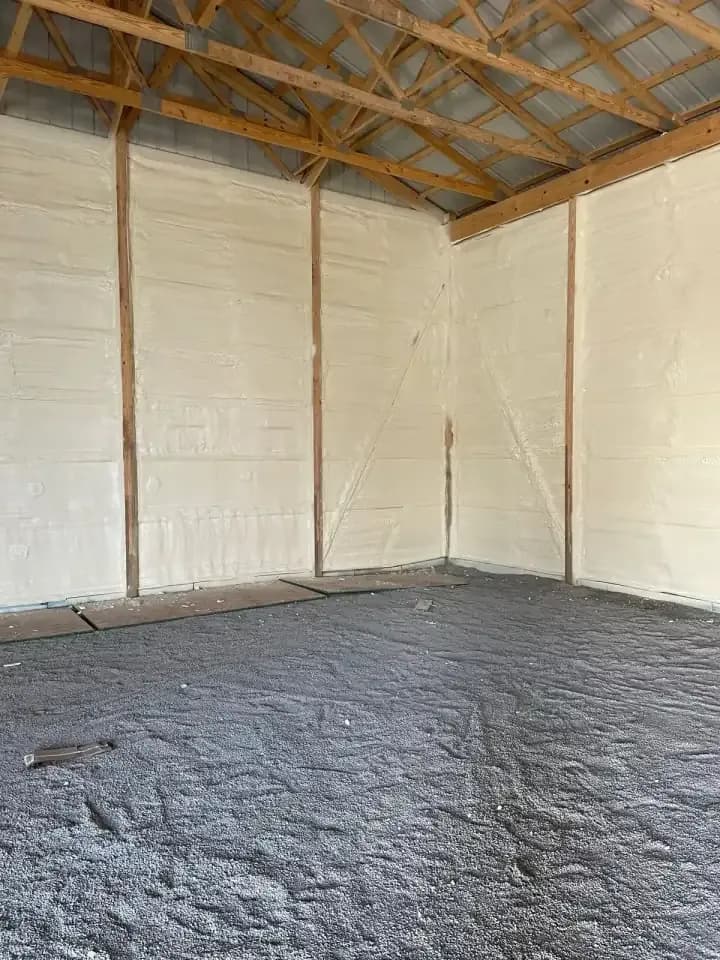
Closed-cell spray foam belongs on the metal walls and roof of a rural Indiana pole barn. It air-seals panel laps, hits about R-7 per inch, and stops condensation on cold steel. Open-cell or batts that hang away from the metal leave a sweating roof. Board feet — square feet times inches — is how the job is measured.
Hoosier Spray Foam foams shops and barns from the rural edges of Westfield and Zionsville through Boone, Clinton, Tipton, Carroll, Cass, Miami, Grant, and the rest of our Central Indiana counties. The building is usually steel or steel-over-post. The climate is still zone 5. The failure mode is water on the underside of the roof on the first cold morning you heat the shop.
Why do metal pole barns sweat in Indiana?
Steel is a thermal bridge and a vapor-impermeable skin. When you heat a barn in January — a wood stove, a hanging heater, even one bay with a furnace — indoor air holds moisture. That air hits 20-degree steel and drops water. The same thing happens on a humid May night when the roof is still cold.
Condensation rusts fasteners, drips on equipment, and ruins stored hay, feed, or cars. Insulation that is not bonded to the metal leaves a cold steel surface in the condensing path. That is why we spray closed-cell directly to the metal instead of tucking a product into the girts and hoping the roof stays dry.
The pole barn service page is the short version. This article is the rural-building version: walls, roof, board feet, and the jobs we see in Boone and Tipton counties as often as in a Carmel backyard shop.
Why closed-cell on both walls and roof?
Closed-cell does four things a metal building needs:
- Air sealing. It expands into panel laps, screw lines, and eave gaps so wind and humid air stop washing the steel.
- R-value in a thin layer. About R-7 per inch, so a few inches on a girt or purlin actually change the winter heat loss. Closed-cell R-value for Indiana pole barns is the product comparison.
- Vapor control. At about 1.5 inches or more, closed-cell acts as a vapor barrier against that indoor moisture.
- Contact with the metal. Sprayed to the panel, it keeps condensation from collecting on the steel and deteriorating it over time.
You can foam walls and roof as one conditioned shell. You can foam the walls, build a ceiling, and put foam or blown-in above that ceiling. You cannot skip the metal-contact problem on a roof you plan to heat. A ceiling-only plan still needs a story for the steel above it.
How do board feet work on a barn?
A board foot of spray foam is one square foot at one inch thick. A 40-by-60 barn with 14-foot walls is not “a 40x60 foam job” until someone states thickness and which surfaces are included.
Example of the math, not a price: 40 × 14 × 2 long walls is 1,120 square feet of wall. Two 60 × 14 end walls add 1,680. That is 2,800 square feet of wall. At 2 inches, that is 5,600 board feet of wall foam — before the roof, doors, wainscot, or lean-tos. Roof area is the footprint adjusted for pitch. A 4/12 roof on 40 × 60 is more than 2,400 square feet of steel.
That is why two bids that both say “foam the barn” can be different jobs. Ask for:
- Surfaces: walls only, walls and roof, or walls plus a ceiling plane.
- Thickness on each surface.
- Open-cell or closed-cell (closed-cell is our metal-building default).
- Openings, existing liner panels, and whether old material comes out.
How much spray foam costs walks through those variables without fake quotes. Access on a rural site — lane, power, heat for the rig in January — also changes the day.
What about lean-tos, shops, and mixed-use barns?
Rural Indiana buildings are rarely one room. A Clinton County shop might have a heated two-bay, a cold lean-to, and a loft. A Tipton farm building might be equipment storage on one end and a heated office on the other. We foam the conditioned parts as a shell and leave the cold lean-to cold, or we foam the whole building if the owner will heat it.
Mixing a foamed shop with an open hay bay is fine if the wall between them is in the spec. What fails is heating one bay while the roof steel is still bare and shared with the cold bay. Condensation shows up on the cheap side of that shortcut.
Under-slab or floor foam is a separate decision when the barn has a slab you want warmer in January. See under-slab spray foam and pole barn floors.
Is open-cell ever right on a metal barn?
Open-cell is about R-3.5 to R-4 per inch and vapor-open. It does not make a vapor barrier. On a metal roof it can hide the steel and still leave a condensing surface, or hold water against the panel. We do not use it as the default on pole barn walls or roofs in this climate. Interior partitions inside an already-foamed shop are a different conversation.
Faced fiberglass that sags off the purlins has the same metal-contact problem. If you can see shiny steel above the insulation, the steel can still sweat.
What should a Boone or Hamilton County owner prepare before we arrive?
Clear a lane for the rig. Know which bays will be heated. Pull stored items off the walls. Tell us about liner panels, existing bubble foil, or a ceiling you want to keep. Photos of the steel and the eave help the estimate. Hiring a spray foam contractor covers insurance and photo questions that apply to barns as well as houses.
We are in Westfield and regularly run west and north into rural Boone, Clinton, Carroll, and Cass counties, and east toward Hancock, Madison, and Grant. If the building is a house foundation instead of a barn, start with crawlspace encapsulation or basements.
Next step
Call 317.210.2931 or request an estimate. Weekdays 8am–5pm, 15001 Shelborne Road, Westfield.
Ready for a local look at your building?
Call 317.210.2931 or request an estimate. Weekdays 8am–5pm, 15001 Shelborne Road, Westfield, IN 46074.