
2026-09-01
Blown-in insulation vs spray foam in Central Indiana
By Hoosier Spray Foam
When blown-in cellulose or fiberglass fits a Central Indiana home, and when closed-cell or open-cell spray foam is the better assembly — an educational comparison, not an attic sales pitch.
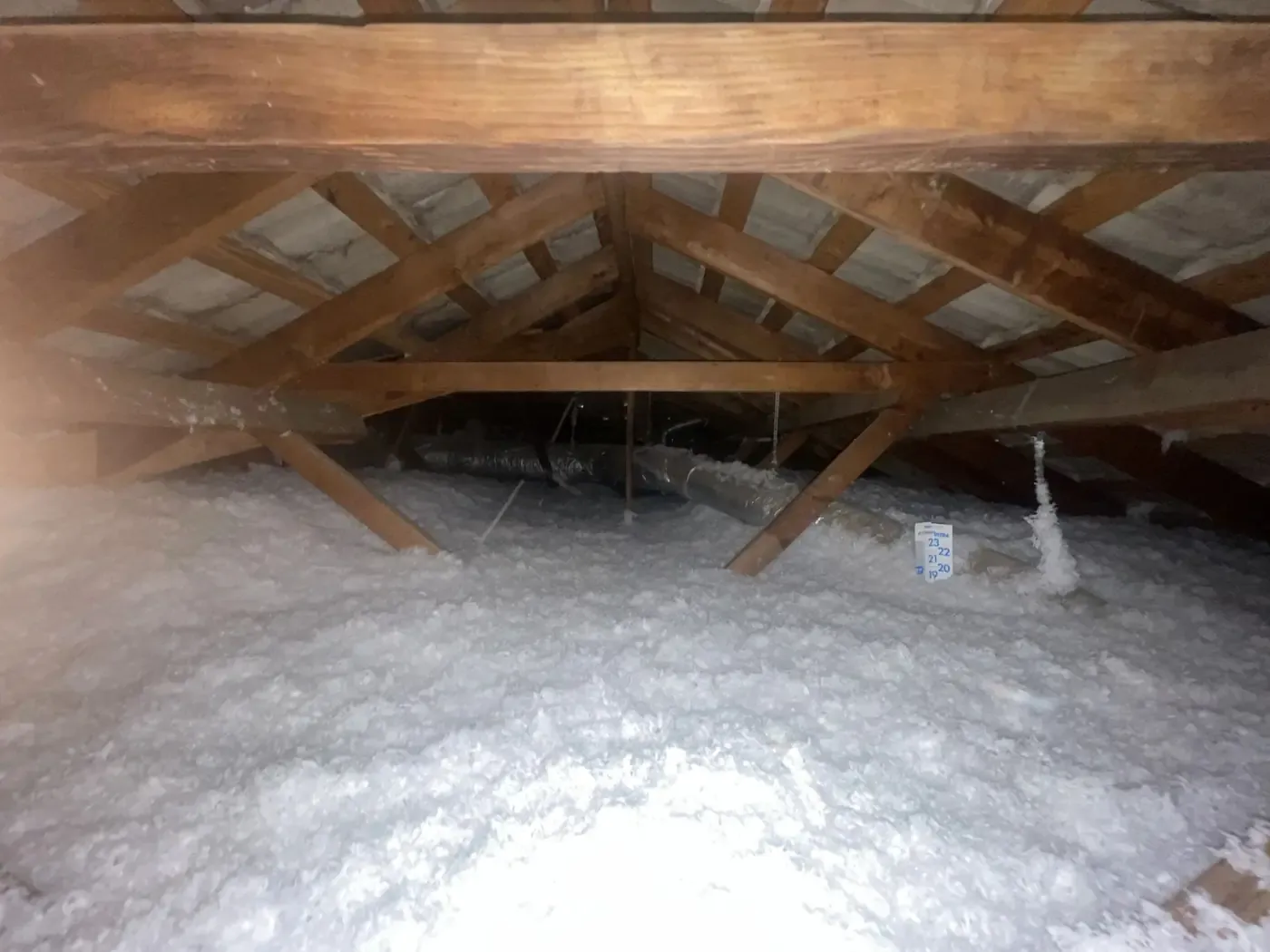
Blown-in insulation is the better spend when you need depth and cost per R on a flat plane after air leaks are already sealed. Spray foam is the better spend when the assembly needs air sealing, a vapor retarder, or R-value in a thin, wet, or metal space. Many Central Indiana houses use both.
Hoosier Spray Foam installs blown-in and spray foam from Westfield through Carmel, Fishers, Noblesville, Zionsville, and the surrounding counties. This is a comparison of materials and assemblies. It is not a campaign to sell a particular attic package. If your question is a crawl, a rim, or a barn, start there.
What does each product actually do?
Closed-cell spray foam is dense, about R-7 per inch, and at about 1.5 inches or more it acts as a vapor barrier and an air seal. It belongs on rims, crawl and basement walls, exterior walls in climate zone 5, and metal buildings. See why open-cell stays off exterior walls and pole barn R-value.
Open-cell spray foam is lighter, about R-3.5 to R-4 per inch, and vapor-open. It is a coverage and sound product for interior cavities and for assemblies that are designed to dry. It is not the exterior-wall or metal-roof default in Indiana.
Blown-in cellulose or fiberglass is loose-fill. It fills a cavity or covers a plane. It does not air-seal by itself. It does not make a vapor barrier. It is often the right way to add R after foam or caulk has already stopped the leaks.
The closed-cell vs open-cell article is the foam-to-foam split. This article is foam versus blown-in.
When is blown-in the better fit?
Blown-in fits when:
- The leaks are already handled (rim foamed, bypasses sealed, or the plane is not the air barrier).
- You need a lot of R and you have the inches to put it in.
- The surface is a floor, a ceiling, or a pole-barn ceiling after the walls are foamed.
- Budget should go to depth rather than to a second foam product.
A pole barn is a clear example. Closed-cell on the metal walls (and often the roof) does the air seal and condensation control. If you then build a ceiling, blown-in above that ceiling can be the cheap R. That mix is already how we talk about barns on the pole barns page.
A house rim is the opposite example. Blown-in cannot seal the sill crack. Stuffing loose-fill into a rim bay is a mess and still a leak. Use closed-cell. Rim joist insulation is that job.
When is spray foam the better fit?
Choose foam when the assembly fails on air or moisture, not only on R:
- Exterior walls in zone 5 (closed-cell, per IRC R702.7 vapor-retarder logic).
- Crawlspaces and basement walls that need a bonded, low-perm layer.
- Metal buildings that sweat.
- Thin cavities where you cannot give up a foot of depth.
- Band joists and other leaky wood-to-concrete lines.
Open-cell can still be the foam for interior walls and some dry, designed-to-dry ceilings. It is not a substitute for blown-in on a big horizontal plane, and it is not a substitute for closed-cell on the weather shell.
Can I mix blown-in and spray foam in the same Central Indiana house?
Yes. That is common. A Westfield house might get closed-cell at the rim and crawl, open-cell or nothing in interior partitions, and blown-in on a sealed ceiling plane. A Zionsville shop might get closed-cell on steel and blown-in above a ceiling. A Fishers basement might get foam only at the band, with no blown-in at all.
Mixing fails when someone uses blown-in as if it were an air seal, or uses open-cell as if it were closed-cell. The product has to match the layer’s job.
How should I compare two bids that are different materials?
Do not compare “R-38 blown-in” to “2 inches of foam” as if they were the same line item. Ask:
- What is the air barrier in this assembly?
- What is the vapor retarder, and does zone 5 require one here?
- Where does water go if it gets in?
- Which inches are foam and which are loose-fill?
How much spray foam costs explains foam variables. Blown-in is usually priced by square feet and settled depth, not board feet. A contractor who will only sell one product for every surface is selling inventory, not an assembly. Hiring a spray foam contractor applies even when part of the job is blown-in.
What about existing insulation that is already there?
If the existing material is dry, in place, and not blocking the new work, we may leave it and add what the assembly still needs. If it is wet, contaminated, fallen, or in the way of a crawl liner or a rim seal, it comes out. Removal is a scope line, not a scare tactic. We are not using this article to market mold work.
Next step
Call 317.210.2931 or request an estimate. Weekdays 8am–5pm, 15001 Shelborne Road, Westfield. Boone, Hamilton, Tipton, Howard, Clinton, Miami, Hancock, Madison, Hendricks, Carroll, Grant, and Cass counties.
Ready for a local look at your building?
Call 317.210.2931 or request an estimate. Weekdays 8am–5pm, 15001 Shelborne Road, Westfield, IN 46074.