
2026-09-07
Batt insulation vs spray foam R-value in Indiana
By Hoosier Spray Foam
R-value alone doesn’t tell the whole story in climate zone 5. Compare fiberglass batt vs closed-cell and open-cell spray foam for walls, rims, and assemblies in Central Indiana.
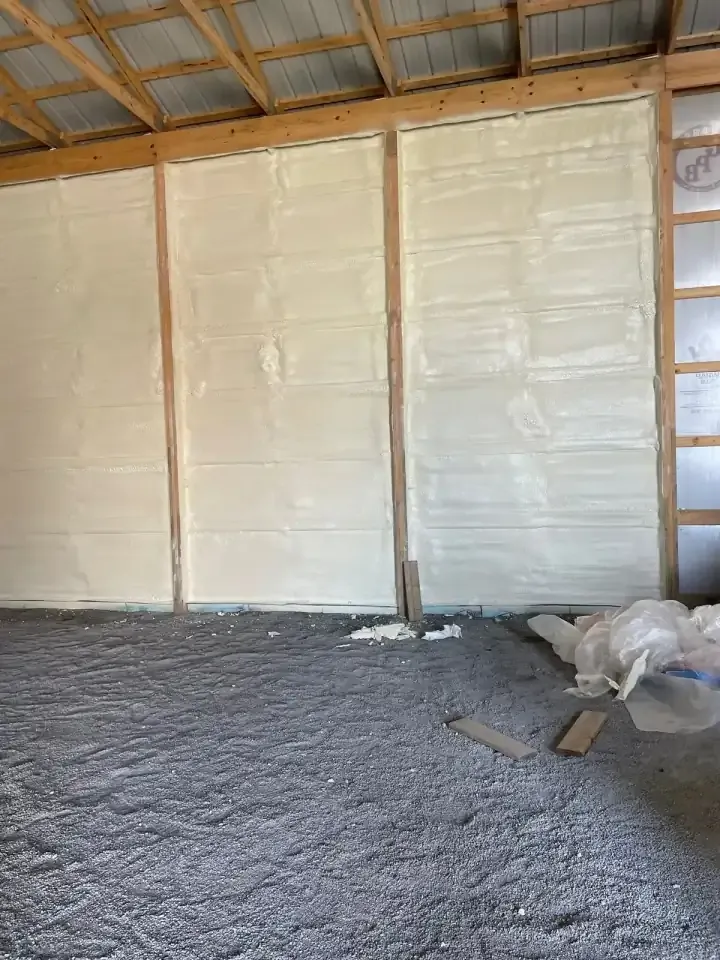
R-value measures resistance to conductive heat flow. In Central Indiana (climate zone 5), that number matters, but it is only one part of how a wall, rim joist, crawlspace, or pole barn performs. Fiberglass or mineral wool batts and spray foam can show similar labeled R-values at a given thickness and still behave differently once they are installed, because air leakage and thermal bridging often move more heat than the insulation itself.
Hoosier Spray Foam is at 15001 Shelborne Road in Westfield. We install closed-cell and open-cell spray foam, and we also work with cavity insulation, for homes and buildings around Carmel, Fishers, Noblesville, Zionsville, and the rest of Hamilton County and Central Indiana. This is a comparison of labeled R-value versus installed assemblies. It is not an attic sales pitch.
What do typical labeled R-values look like?
These are industry ranges, not a certificate for every brand or every winter morning:
- Fiberglass batt: about R-3.1 to R-4.3 per inch. Common wall batts are often R-13 or R-15 in a 2x4 cavity and R-19 or R-21 in a 2x6.
- Mineral wool batt: often about R-4 per inch.
- Open-cell spray foam: about R-3.5 to R-4 per inch.
- Closed-cell spray foam: about R-6.5 to R-7 per inch.
Closed-cell usually wins on labeled R at the same thickness. Open-cell and many batts can look similar per inch. The bigger question is whether you have an airtight, continuous assembly — or gaps, compression, and framing that short-circuit the cavity fill.
The closed-cell vs open-cell article is the foam-to-foam split. Blown-in vs spray foam covers loose-fill after air sealing. This page stays on batts versus foam, and on why the bag R is not the wall R.
Why do batts often underperform the label?
A batt only delivers its labeled R if it fills the cavity without gaps, compression, or voids. That is harder than the bag makes it look. A folded edge, a wiring run, or a bay that is a half-inch too narrow can leave a path that the label never counted.
Wood studs are thermal bridges. Heat flows through the framing around the insulation. A 2x4 wall with R-13 batts is not an R-13 wall. The labeled number describes the cavity fill, not the whole assembly. Plates, headers, and corners are part of the wall too. Thermal bridging in climate zone 5 Indiana is where those paths show up in local walls, rims, and metal buildings.
Batts do not air-seal by themselves. Air can move around the edges, through splices, and at the sill or top plate. Air movement carries heat and moisture. In climate zone 5, winter indoor air holds more moisture than the outdoor air. If that air reaches cold sheathing, you have a moisture problem as well as a heat-loss problem. Air sealing vs R-value in climate zone 5 Indiana explains why sealing the air plane comes before adding more R.
None of that means batts are useless. It means the label is a starting point, not the performance of the wall.
What does spray foam change?
Spray foam expands to contact the substrate. When it is installed correctly, it can air-seal the surface it touches — wood, concrete, or steel — and cut the gap tax that batts leave behind.
Closed-cell is high R per inch and a strong air seal. At roughly 1.5 inches or more it can serve as a vapor retarder. That is why we use it on exterior walls, rim joists, crawlspaces, and pole barn metal in Indiana. See rim joist insulation, crawlspace encapsulation, basements, and closed-cell R-value on pole barns.
Open-cell is lower R per inch and vapor-open. It does not play that vapor-retarder role on exterior walls in climate zone 5 under IRC R702.7 thinking. We do not put open-cell on Indiana exterior walls. Why open-cell should not go on exterior walls is the climate-zone article.
Versus batts, foam reduces the gap tax and often improves whole-assembly performance — not because the bag says a higher number, but because the installed layer is continuous and sealed.
How should I read R-value versus whole-wall performance in zone 5?
Do not pick from a per-inch chart alone.
A 2x4 wall with R-13 batts is still a framed wall with studs, plates, boxes, and seams. Closed-cell can meet a useful cavity R in less depth and cut air leakage at the same time. That is why a thinner foam layer can outperform a thicker batt layer on the same wall: the foam is doing air sealing the batt never did.
Rim joists are a clear example. Batts stuffed in the band often leave the sill crack open. Closed-cell at the rim air-seals wood to concrete. In zone 5 we commonly treat the rim as about R-20. Rim joist insulation in Indiana basements is that job.
Pole barns are the extreme case. Metal is a thermal bridge and a condensation surface. Closed-cell bonded to the steel is an assembly fix. Batts behind metal without a continuous air and vapor strategy struggle in Indiana winters. That is the pole barns story, not a batt-thickness contest.
When do batts still make sense?
Batts can still be the right spend when:
- The cavities are clean and accessible.
- The air barrier is handled separately — foam at the rim, caulk at bypasses, or a real air-sealed plane.
- Budget favors cavity fill after the leaks are closed.
- You are topping up an attic floor after air sealing, not asking the batt to be the air seal.
That last point is education, not an attic package. If the assembly fails on air or moisture, fill the cavity after you fix the leaks — or use a product that can do both.
You can sometimes mix batts and spray foam. Foam at rims and edges, cavity insulation elsewhere, is common if moisture and air are designed as one system. Do not mix casually on exterior walls without a plan. Zone 5 exterior walls need a warm-side vapor strategy. Closed-cell can be that layer. A batt plus a guess is not.
Bottom line
Do not pick insulation from a per-inch R chart alone. Ask about air sealing, thermal bridging, and moisture in climate zone 5. Higher labeled R helps conduction. Installed assembly performance is what the house actually does.
Next step
Call 317.210.2931 or request an estimate. Weekdays 8am–5pm, 15001 Shelborne Road, Westfield, IN 46074. We serve Central Indiana — Hamilton County and nearby counties listed on the homepage.
Ready for a local look at your building?
Call 317.210.2931 or request an estimate. Weekdays 8am–5pm, 15001 Shelborne Road, Westfield, IN 46074.