
2026-09-22
Thermal bridging in climate zone 5 Indiana
By Hoosier Spray Foam
In climate zone 5, wood studs, plates, steel, and rim joists short-circuit cavity R-value. How thermal bridging works in Central Indiana homes and pole barns — and what closed-cell spray foam changes.
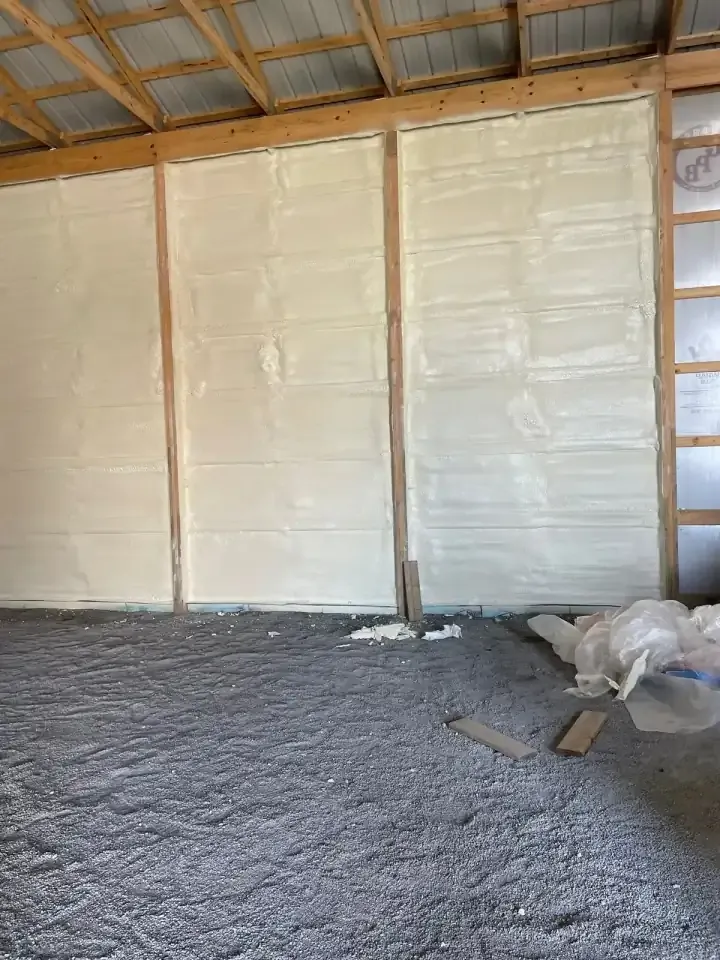
Thermal bridging is heat flowing through the conductive parts of a building — studs, plates, headers, steel, concrete edges — instead of through the insulation in the cavity. In Central Indiana (climate zone 5), that path matters as much as the bag R-value on the batt or foam. A wall labeled R-13 in the cavity is not an R-13 wall once framing takes a large share of the surface.
Hoosier Spray Foam is at 15001 Shelborne Road in Westfield. We install closed-cell and open-cell spray foam for homes and buildings around Carmel, Fishers, Noblesville, Zionsville, and the rest of Hamilton County and Central Indiana. This guide explains thermal bridging in plain language. It is education about assemblies — not an attic sales pitch.
What is a thermal bridge?
Insulation resists conductive heat flow. Framing and metal do not. Where wood, steel, or concrete runs continuously from the warm side toward the cold side, heat takes the easier route through that material. Builders call that path a thermal bridge.
In a typical wood-frame wall, the cavity may hold fiberglass, mineral wool, or foam, while the studs, top and bottom plates, and headers sit beside that fill. The labeled R describes the cavity product. Whole-wall performance averages the cavity and the framing. The more framing you have — corners, windows, tight stud spacing — the more the bridge tax grows.
Air leakage is a different problem. Leaks move heat by air flow. Bridges move heat by conduction through solids. Indiana winters punish both. Many Central Indiana homes feel “drafty” at the perimeter even when cavities look full, because the rim, sill, and studs are still cold conductors. For how air leaks and labeled R-value work together, see air sealing vs R-value in climate zone 5 Indiana.
For labeled R-value versus installed assemblies, see batt insulation vs spray foam R-value in Indiana. For foam type choice, see closed-cell vs open-cell.
Why climate zone 5 makes bridging worse to ignore
Climate zone 5 has cold winters and warm, humid summers. Winter indoor air is much warmer and often more moisture-laden than outdoor air. Heat wants to leave. Where a stud or steel panel stays cold, that surface can also become a place where moisture condenses if humid indoor air reaches it.
That is why assembly design in Indiana is not only “more inches of fill.” Continuous paths through framing or metal keep moving heat after the cavity looks thick. In milder climates the same bridge still exists, but the temperature swing is smaller, so the comfort and condensation cost is lower. Here, cold spots at exterior corners, band joists, and metal buildings show up fast.
Indiana exterior walls also need a warm-side vapor strategy under IRC R702.7 thinking. Open-cell is vapor-open and is not the foam we use on exterior walls in this climate. Closed-cell at roughly 1.5 inches or more can serve as a vapor retarder while also air-sealing. Details: why open-cell should not go on Indiana exterior walls.
Where thermal bridges show up in Central Indiana buildings
Wood-frame walls. Studs, plates, and headers bridge around batts or loose cavity fill. A 2x4 wall with R-13 batts is a framed assembly, not an R-13 blanket.
Rim joists and the sill. The band joist sits on the foundation and meets the first-floor framing. Batts stuffed in the bay often leave the sill crack open and leave wood-to-concrete edges exposed. Closed-cell at the rim air-seals and cuts that perimeter bridge. Zone 5 guidance commonly treats the rim as about R-20. See rim joist insulation in Indiana basements and basements.
Crawlspaces. Cold foundation walls, rim edges, and vented air paths pull heat from the floor above. Encapsulation and foam at the walls and rim address conduction and air together. See crawlspace encapsulation and crawlspace encapsulation in Central Indiana.
Pole barns and metal buildings. Steel is an extreme thermal bridge and a condensation surface. Closed-cell bonded to the metal is an assembly fix, not a batt-thickness contest. See pole barns, closed-cell R-value for Indiana pole barns, and pole barn spray foam in rural Indiana.
Windows, doors, and corners. Headers and jack studs add framing. Exterior corners pack more wood into a small area. Those spots feel cold even when mid-wall cavities look fine.
What spray foam changes — and what it does not
Spray foam expands to contact the substrate. Correctly installed closed-cell foam can air-seal wood, concrete, or steel and raise R per inch (about R-6.5 to R-7). That helps two ways: less air movement past the assembly, and more insulation in less depth where space is tight (rims, metal, irregular cavities).
What foam does not magically erase: wood studs still conduct heat if the only insulation sits between them and nothing continuous covers the framing. Cavity foam improves the bay and seals gaps; continuous exterior insulation (or foam that covers framing edges by design) is what truly breaks the stud bridge. On metal buildings, foam sprayed to the steel changes the story because the foam becomes the continuous layer on the conductive skin.
Open-cell is lower R per inch and vapor-open. It can help air-seal some interior or designed assemblies, but it is not our exterior-wall foam in Indiana climate zone 5.
Batts and blown-in still have a place when cavities are clean and the air barrier is handled separately — for example after rim sealing, or as attic-floor fill after air sealing. See blown-in vs spray foam.
How to think about “more R” versus “fewer bridges”
Ask three questions before chasing a higher bag number:
- Is the assembly continuous? Gaps and compression create air and heat paths the label never counted.
- What materials punch through the insulation plane? Studs, steel, rim, slab edge.
- Is moisture controlled for zone 5? Especially on exterior walls and metal — closed-cell and vapor strategy matter.
Higher labeled R helps conduction through the insulation itself. Thermal bridges and air leaks can erase that gain at the whole-wall or whole-building scale. Comfort complaints at cold corners, cold first-floor edges, and sweating metal buildings are often bridge-and-air problems, not “one more inch of batt” problems.
Bottom line
In climate zone 5 Indiana, thermal bridging is why a cavity R-value is not the same as wall or building performance. Wood, steel, and rim details short-circuit fill that only sits in the bay. Closed-cell spray foam helps most where it seals and covers conductive surfaces — rims, crawl edges, basement walls, and pole barn metal — and where exterior walls need both insulation and vapor control. Match the product to the assembly; do not pick from a per-inch chart alone.
Next step
Call 317.210.2931 or request an estimate. Weekdays 8am–5pm, 15001 Shelborne Road, Westfield, IN 46074. We serve Central Indiana — Hamilton County and nearby counties listed on the homepage.
Ready for a local look at your building?
Call 317.210.2931 or request an estimate. Weekdays 8am–5pm, 15001 Shelborne Road, Westfield, IN 46074.