
2026-10-05
Spray foam assemblies that work in climate zone 5 Indiana
By Hoosier Spray Foam
Which spray foam assemblies hold up in Central Indiana's climate zone 5: exterior walls, flash-and-batt, roof decks, rim joists, basements, crawlspaces, and pole barns.
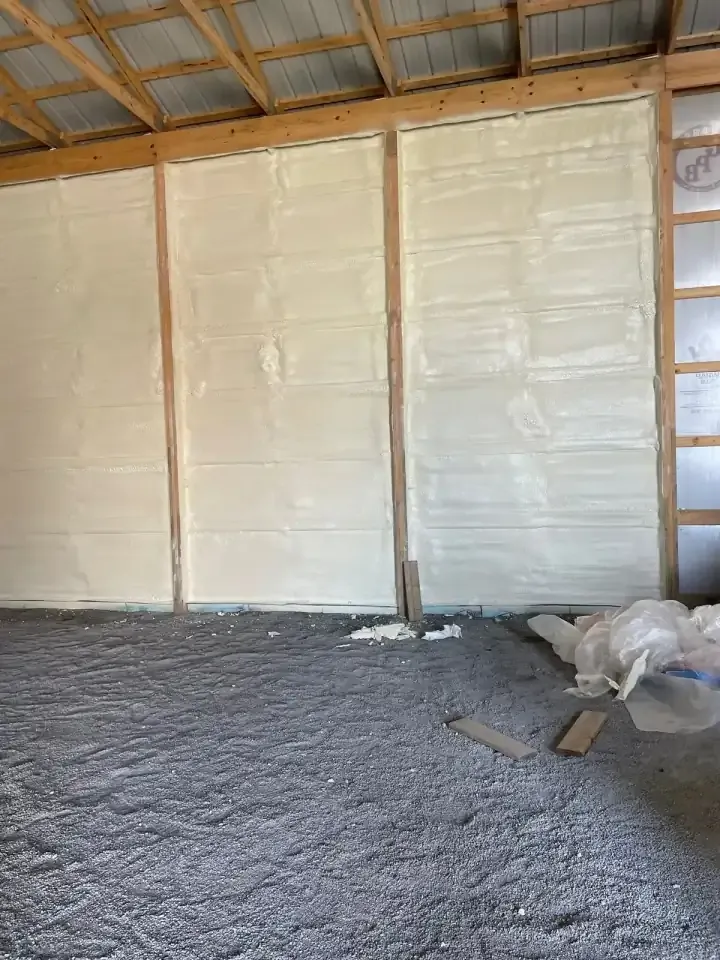
The right spray foam assembly in Central Indiana depends on where the foam sits in the building. Exterior walls, rim joists, basement and crawlspace walls, and pole barns get closed-cell foam, because it insulates, air seals, and acts as a vapor retarder in one layer. Open-cell belongs only in spots that are not the cold weather shell, or in roof assemblies designed to dry. A hybrid "flash-and-batt" wall can work when the closed-cell layer is thick enough to do its job.
Hoosier Spray Foam is at 15001 Shelborne Road in Westfield. We insulate homes and buildings in Westfield, Carmel, Fishers, Noblesville, Zionsville, Indianapolis, and the surrounding Central Indiana counties. This guide walks through each assembly in plain language, so you know what to ask before anyone sprays.
What "assembly" means and why it matters here
An assembly is the whole layer cake of a wall, roof, or floor: siding or metal, sheathing, framing, insulation, any vapor retarder, and the interior finish. Insulation is only one layer. How the layers handle heat, air, and moisture together decides whether the wall stays dry and comfortable.
Climate zone 5 has cold winters and humid summers. In winter, warm indoor air carries moisture outward. If that air reaches a cold surface inside the wall, it can condense. That is why the Indiana question is never just "how many inches." It is "which foam, where, and what keeps the cold side dry." For the heat-flow side of this, see thermal bridging in climate zone 5 and air sealing vs R-value.
Exterior walls: closed-cell, full or hybrid
Exterior walls are the building's weather shell, so the foam has to control vapor as well as heat and air. The IRC (R702.7) calls for a warm-side vapor retarder on frame walls in climate zone 5. Closed-cell foam at roughly 1.5 inches or more works as that vapor retarder. Open-cell does not, which is why we don't put open-cell on Indiana exterior walls. The full reasoning is in why open-cell should not go on Indiana exterior walls.
You have two closed-cell options for a stud wall:
- Full closed-cell. Foam fills most or all of the bay. You get the most R-value per inch, a strong air seal, and added racking strength. It costs more per wall.
- Flash-and-batt (hybrid). A layer of closed-cell is sprayed against the sheathing, then the rest of the bay gets a batt or blown fill. The foam does the air sealing and vapor control; the batt adds cheaper R-value. It only works when the foam layer is thick enough to keep the inner foam surface warm and to act as the vapor retarder. A thin skim coat leaves the batt side cold and defeats the point.
Either way, the studs still bridge heat. Foam in the bay doesn't stop that. Exterior continuous insulation (rigid foam over the sheathing) is what cuts the bridging, and it's usually a new-build or re-side decision.
Roof decks and vaulted ceilings
Spraying foam to the underside of the roof deck turns the attic or vault into conditioned space. That can make sense for cathedral ceilings, bonus rooms, or attics with ductwork, but it is a design decision, not a default.
- Closed-cell at the deck adds an air seal and vapor control right at the sheathing and holds up well in tight vaulted rafters where depth is limited.
- Open-cell at the deck can work in roofs designed to dry inward, usually with a vapor-control plan on the interior side. It is not the same job as an exterior wall.
Many attics are better served by air sealing the attic floor and adding blown-in insulation above it. Our blown-in vs spray foam guide compares the two.
Rim joists
The rim joist is the band of framing sitting on the foundation. It is a classic air-leak and cold spot in Indiana basements and crawlspaces. Closed-cell sprayed into each rim bay seals the gaps, insulates, and controls vapor at the spot where fiberglass usually fails. See rim joist insulation in Indiana basements.
Basement and crawlspace walls
Foundation walls are cold, damp masonry. Closed-cell bonds directly to concrete or block, doesn't absorb water, and doesn't need a separate plastic vapor layer behind a stud wall. That makes it the standard choice for basement walls and for encapsulated crawlspace walls, paired with a ground vapor barrier on the floor of the crawl. See crawlspace encapsulation in Central Indiana and crawlspace vs basement in Hamilton County.
Pole barns and metal buildings
Steel panels get very cold and condense on the inside when warm, humid air hits them. Closed-cell sprayed directly to the metal stops that condensation surface, air seals the panel laps, and adds stiffness. Open-cell is a poor fit against steel for the same moisture reasons. Details are in closed-cell R-value for Indiana pole barns and pole barn spray foam in rural Indiana.
Where open-cell does fit
Open-cell is lighter, softer, and less expensive per inch. Inside the house, it's a good sound and air-sealing fill for interior walls, floors between levels, and some roof assemblies designed to dry. It is the wrong foam wherever the assembly faces Indiana's cold and needs a vapor retarder. See closed-cell vs open-cell.
Quick reference
| Location | Foam we use in Central Indiana | Why |
|---|---|---|
| Exterior stud walls | Closed-cell (full or flash-and-batt) | Vapor retarder under IRC R702.7, air seal |
| Roof deck / vaulted ceiling | Closed-cell, or open-cell in a dry-to-inside design | Depends on the roof design |
| Rim joists | Closed-cell | Air seal + vapor control at the band |
| Basement / crawlspace walls | Closed-cell | Bonds to masonry, doesn't absorb water |
| Pole barn metal | Closed-cell | Stops condensation on steel |
| Interior walls and floors | Open-cell | Sound and air sealing, no weather exposure |
Next step
Every building is a little different. We'll look at the wall, roof, or foundation and recommend the assembly that fits it. Call 317-210-2931 or request a free estimate. We're open Monday through Friday, 8am to 5pm, at 15001 Shelborne Road, Westfield.
Ready for a local look at your building?
Call 317.210.2931 or request an estimate. Weekdays 8am–5pm, 15001 Shelborne Road, Westfield, IN 46074.